

Upcycling is very close to our hearts
Wasted Threads emerged from the simple idea and a ‘what if?’… What if every individual could reuse and remake their own clothes from existing fabrics they already have in their wardrobe? And what if we gave them the right tools, and professional instructions on how to do it?
Spoiler: We obviously think upcycling is great because it’s what we’re all about. We make PDF patterns so that you can reuse the clothes and fabrics that you already have, to create fashionable pieces for your wardrobe while avoiding fast fashion and its problems like the plague.
That said, you might be unsure about what upcycling is in the first place. You might also have some preconceptions, and even some misconceptions about upcycling or its alternatives. Well, we’re here to address them and answer some frequently asked questions about upcycling in as much detail as we can!
Throw Away Fashion Creates a Lot of Waste
We all know that we cannot sustain the level of fashion now being made and discarded, most of which goes into landfill. Every second a truckload of garments is sent to landfill or incinerated. It won’t work in the long term. Change is coming in the fashion industry, with both new laws in place, and consumers demanding better.
In April 2023, a Greenpeace report on Greenwashing in the fashion industry, highlighted some startling statistics on the amounts of clothing bought and the amounts of waste produced. These show that more change is urgently needed.
Huge quantities of clothes and fabrics are being wasted and there’s no sign of slowing down:
o Vast amounts of new fashion produced goes into landfill before it even gets to a consumer, as 25% of all new garments made are never sold.
o Clothing production doubled in 14 years from 2000 to 2014. (Up to 100 billion items in 2014). This figure is projected to be over 200 billion items by 2030.
o The recycling consumer in the EU discards about 11 kgs of textiles per year.
Sustainability is a hot topic but still only a few people and brands are actually taking action:
o Currently, in the fashion industry, less than 1% of clothes are recycled into new clothes, with new garment production volumes growing at 2.7% each year.
o Only 3% of clothes are made from recycled materials and most are made from recycled plastic bottles which are then only recycled once and are not then recycled again.
o Less than 1% of all clothes are made from old textiles commercially.
What is Upcycling and Why Should We Care?
What is Upcycling?
Upcycling is the process of using old or discarded items to make something new. Upcycled clothes are crafted from surplus materials, adding value in the upcycling process, rather than simply recycling an item. Using unwanted clothing, textiles, factory scraps, or deadstock, that would otherwise contribute to landfill waste.
Why Sew Your Own or Upcycle Clothes?
There are many reasons to sew your own and upcycle!
As an individual, you can make a difference by reusing, recycling, and remaking clothes for your wardrobe. Many people feel that their own small impact is not effective, and feel helpless and unempowered, but each individual action is effective and can empower the Fashion Makers and Big Brands to take more positive action. Collectively, by re-making our clothes ourselves we can become significant on a larger scale.
Since making your own fashion is something you can do yourself, no labels are needed to tell you where your garment came from this second (or third) time around. Not to mention how satisfying it can be to wear something that you made yourself!
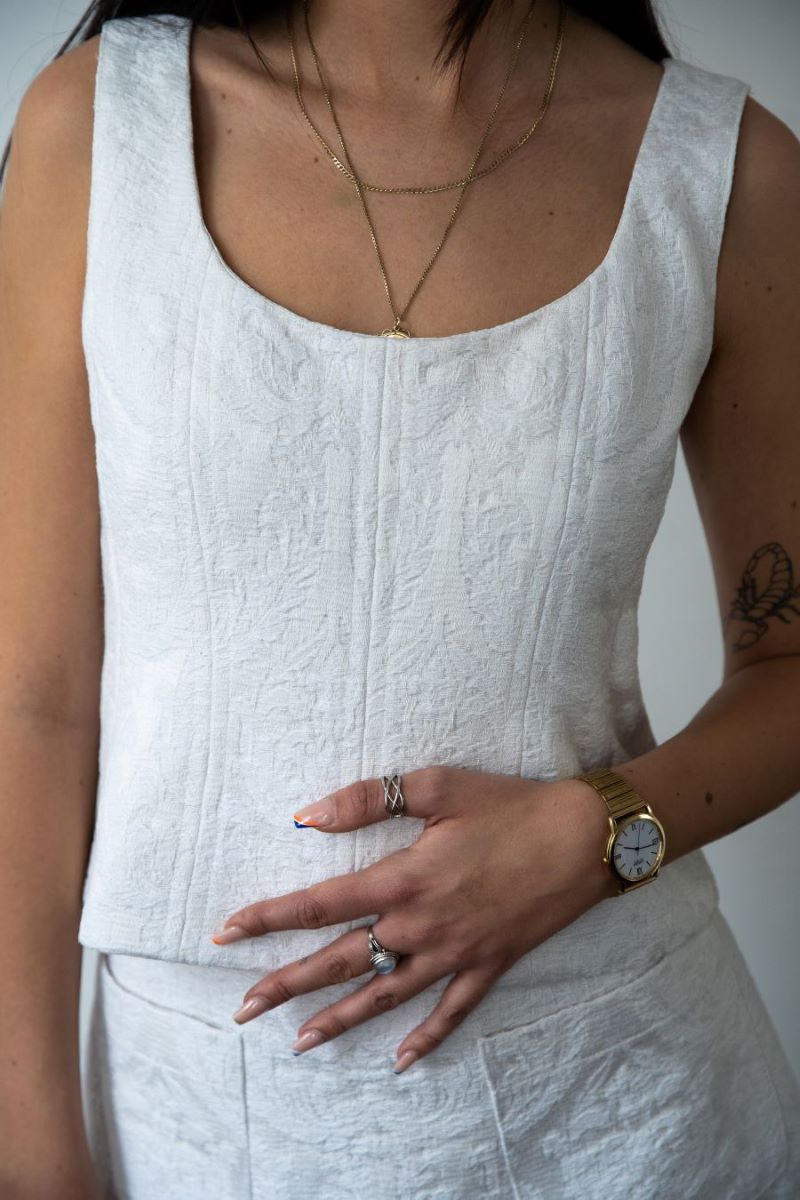
We made our figure-hugging Bridgit Bodice PDF Pattern from a set of heavy damask curtains that weren’t being used anymore!
Is Upcycling popular?
In short, yes – and it’s becoming more popular. So many people are looking for better, more sustainable fashion options, choosing sustainable brands and looking for environmentally friendly materials.
Sewing and upcycling for fashion is becoming extremely popular as people learn the creative skills needed to create new things, and to make something unique and new for themselves.
Buying second-hand clothes is also hugely popular and growing, but not everything you can find as a one-off is going to be in your size or look good on you. You may need to be creative to take something great that you already own, be it some fabric or a garment, and make it into something new.
Why Upcycle clothes and textiles? What are the effects of upcycling clothes?
Upcycling into something new from something older minimizes the amount of material thrown away, and so prevents these from being sent to landfill or incinerated.
Using raw materials and deadstock or remnant fabrics that are already in circulation reduces the need for precious resources that go into the making of new fabrics and clothes.
Reducing the use of new raw materials for clothing production, reduces Carbon and C02 emissions, reduces water use, hazardous chemicals use, and air pollution.
Even If you buy an item in a charity or thrift store to use the fabric to remake into a new fashion item for yourself, you are paying for something that has some existing, residual value and gives the charity revenue to use in other charitable ways.
Does upcycling save money?
Keeping clothes and textiles out of landfill can save money on transport, logistics, packaging, and disposal costs. Producing less saves those costs of production, and to the environment by not depleting natural resources or by increasing waste.
If you can use your own wardrobe to upcycle, then you may only have the cost of our pdf Pattern pack, and any trims to make and re-make, and as your own labour is also free, you are saving money by not buying new.
One thing to note too, is that labour costs paid to those who make your clothes in the fashion industry are often low, so you are often not paying the true cost of labour and time taken to make when you buy something new.
Common Concerns & Misconceptions
I always give my clothes to a charity shop – so they’re recycled, right?
Charity and thrift shops do a great job of reselling your unwanted clothes. This gives them a much-needed charity income. However, all major charities have recently bemoaned the fact that they are no longer receiving good quality clothes donations and it used to be that the highest value donations bring them the highest revenue, now people are selling ‘all their ‘good stuff’ on resale platforms and not donating these.
Charity shops are often now getting all the damaged, torn, worn-out and lesser-quality items that they’re not able to sell. These unsold items are often then moved on and sold by the kilo/ tonne in large bundles for a low value to be disposed of in bulk.
These large bulk textile lots end up being shipped out in container shipping loads to poorer countries in Africa, Asia and South America, where they often can’t be sold there either as the quality is too poor. So, after a very long journey, they end up in a landfill after all.
A clothing dump caused by this kind of activity in Chile was in the news again in June 2023 when the landfill was seen from space, containing thousands of tonnes of unsold clothes from Europe and all over the world.
Not to mention the socioeconomic effects this can have on countries that receive all these clothes.
By all means donate high quality clothes to charity shops, or better yet give them the money you would have spent on new clothes after you make your own from what you already have!
I always sell my clothes on resale platforms when I no longer want them – isn’t that better for the environment?
Resale platforms are a great way of letting other people wear the clothes you no longer want to wear and might even give you some money for them. It is possible though that rental or resale platforms may now even increase consumption from fast fashion brands. If you think you can resell it after a couple of wears, move it on and maybe even make money while doing it, why not buy more than you need?
Many brands are now even producing specifically for rental and resale markets rather than for direct sale since more people are looking at rental and resale as a solution to the fast fashion problem – the irony!
The amount of clothes available across all these platforms then becomes a vast amount of stock in itself, and not all will be popular for rental or purchase. This unrented, unsold stock then needs to be disposed of. Sound familiar?
If you’re looking to rent clothing and the item you want to rent comes in various sizes, think about why this might be? Is this produced specifically for rent? or is it an unwanted over-production line? Neither situation is a good one, and both are creating the same problem of items being discarded.
Isn’t it better to keep clothes whole and intact?
Then I can just let others re-wear them through swapping, rental, or resale online?
Wearing your own clothes for longer is the most sustainable option. If you can extend the life of your clothes by making them into something you like and that fits you, then this will extend this life for longer, and be loved and loved again.
What is the downside of sewing your own clothes or upcycling?
There are many contemporary brands and designers that are creating one-offs for sale by upcycling from other styles. Doing this on a large scale is difficult, takes time and probably isn’t financially viable, as making stock using upcycled items can even create more unsold stock problems.
Upcycling your own clothes at home using PDF Patterns and instructions means you’re avoiding this potential issue at the same time as making a beautifully designed new fashion item, at a fraction of the cost of buying. No packaging or shipping either! (Don’t get us started on how fast fashion packaging is bad for the environment.)
Is it hard to sew or upcycle clothes?
Upcycling does not have to be hard, but it takes more time than going to the shop to buy something straight off the hanger. Sewing and upcycling are not instant. It takes time to make something new from something old. You need to allow yourself the time to enjoy making, sewing, and upcycling.
It is a very creative process, from measuring and fitting for yourself, trying it on along the way and making your own decisions on how you want your new item to look at every stage of the making process. You’re making something unique!
The more you sew and make, the more experience and confidence you gain, and your skills continue to build. It’s extremely satisfying. Building up sewing skills on your sewing machine happens very quickly with practice – like riding a bike!
Of course, there are different processes involved depending on what you’re making, and it can help if you have instructions. That’s why we provide very detailed step-by-step instructions and professional fashion designer tips with all our pdf patterns. We even tried to anticipate the questions you might ask as you go along.
Lastly, don’t be afraid to try!
If you do make a mistake, you can unpick it fairly quickly with a stitch unpick and sew it again.

Sewing-Your-Own & Upcycling in the Broader Context
Is upcycling the future for fashion?
Fashion in the future is changing in many ways. Upcycling, or using upcycled textiles to sew your own wardrobe, is one of these – reusing what we have without creating more waste.
Is sewing-your-own and upcycling ‘slow fashion’?
First, it’s helpful to understand what these phrases mean. ’Fast fashion’ is multiple styles being delivered in large volumes and low prices into stores in just a few weeks, regardless of demand. ‘Slow fashion’ is a reference to the opposite of this process, relating to the speed of production and delivery.
So, while upcycling is not technically slow-fashion in the sense that there is no “production and delivery” (unless you’re giving an upcycled piece as a gift!), upcycling contributes to the movement of slow fashion and sustainable fashion in general.
Upcycling plays a part in replacing fast fashion overproduction as it keeps your clothing in circulation for longer. This means less waste in packaging, raw materials and resources, less carbon emissions, less energy, less water and less plastic used, in both production and distribution.
Is sewing your own and upcycling ‘zero waste’?
Not exactly. Very few things are true ‘Zero Waste’ solutions unless the upcycled clothing or fabrics are reused and reused and reused in different ways forever. However, reusing existing items to upcycle is far better than buying new clothes!
Reuse, remake, recycling, and upcycling are all effective for keeping clothing in use for longer, and so all have a positive impact and a benefit over the vast amount of clothing needlessly ending up in landfills.
Is sewing and upcycling in fashion sustainable?
Wearing for longer and upcycling existing clothing is one of the easiest and most effective ways that we as individuals can make fashion more sustainable. Even using fabrics from garments that are nearly new (clothes you’ve only worn a couple of times) to upcycle is far better than buying new.
Using deadstock fabric that is considered no longer viable for commercial production can also help reduce waste and harmful carbon emissions that are generated when producing new items.
Conclusion
In conclusion, the future of fashion is an exciting blend of creativity, sustainability, and individual empowerment. With practices like upcycling and sewing-your-own clothes, we can significantly curtail the environmental footprint of the fashion industry.
By adopting these practices, not only do you bring a personal touch to your fashion, but you also contribute to a broader change in consumer attitudes and a shift towards more sustainable practices.
We love upcycling – it’s our mission to help you reuse and upcycle clothes and fabrics that you already have into on-trend, fashionable pieces for your wardrobe (with the help of our PDF Patterns).
Let’s embrace this new wave of slow fashion, where each stitch is a step towards a more sustainable world. Remember, every thread counts, and together, we can weave the fabric of a more sustainable future.